Designing Human-in-the-Loop AI for Supply Chain
Shortage Replenishment Agent is an AI-assisted procurement prototype that helps supply planners resolve material shortages through evidence-based supplier recommendations, explicit trade-off comparisons, and mandatory override justifications. Built as an extension of the Purchase Order MVP.
Design
Exploration
4
Layer Architecture
3
Trust Patterns
Full
Working Prototype
The Purchase Order MVP established a foundation for transparent procurement workflows. This project extends that work into agentic AI—where an intelligent system recommends suppliers and quantities, but humans remain in control of final decisions.
How this differs from PR-PO Copilot
Conversational AI — Users describe needs in natural language, copilot interprets intent and guides form completion. Focus on understanding what users want.
Recommendation system — System detects problems, ranks solutions, users confirm or override. Focus on helping users choose between options.
Both explore AI transparency, but through different interaction paradigms: one is generative (creates from intent), the other is evaluative (ranks existing options).
Design challenge: How do you build trust in AI recommendations for high-stakes supply chain decisions where errors can halt production lines?
The prototype explores a Calibrated Trust Framework:
- Reliance — Can users depend on the AI's recommendations?
- Correctness — Are recommendations based on verified data?
- Robustness — Does the system handle edge cases gracefully?
- Governance — Is every decision auditable and explainable?
Research Approach
This exploration draws on:
- Domain immersion — Studying supply chain workflows from the Purchase Order MVP project
- Pattern research — Reviewing AI trust frameworks from Google PAIR, Microsoft HAX, and IBM Design for AI
- Analogous experiences — Analyzing how high-stakes recommendation systems (medical, financial) handle human-AI collaboration
Target Outcomes (Hypothetical)
Note: These are hypothetical projections based on industry research, not measured production data. The purpose is to illustrate the types of outcomes this design aims to enable.
40%
Faster shortage resolution
95%
Audit compliance rate
↓60%
Unjustified overrides
How these estimates are derived
- 40% faster resolution: Based on reducing manual supplier research time. Industry benchmarks suggest procurement teams spend 2-4 hours per shortage event on supplier evaluation; automated ranking + evidence chips could compress this to under 1 hour.
- 95% audit compliance: Every action is logged with actor, timestamp, and rule IDs. The override-with-reason pattern ensures even exceptions are documented. Target based on similar audit trail implementations.
- 60% fewer unjustified overrides: When users see evidence chips showing data sources, they're more likely to trust recommendations. Studies on transparent AI systems show reduced override rates when reasoning is visible.
Scope note: This is a design exploration prototype using seeded data and deterministic rules. No real ERP systems or production data are connected.
Before designing the UI, I mapped out how different layers coordinate in this workflow. The principle: "Make the agent's reasoning visible and overridable."
User defines goal: Speed / Cost / Reliability
Supplier scoring · Contract lookup · Price calculation
Preferred suppliers · Contract validation · Override requirements
Evidence chips · Trade-off cards · Override modal · Audit trail
This layered architecture ensures the AI handles scoring and ranking while humans control strategy selection and final decisions—making the workflow auditable and enterprise-safe.
System flowchart: Detection → Resolution workflow
This diagram maps the complete workflow, showing how the system handles shortage detection, strategy selection, and human decision points.
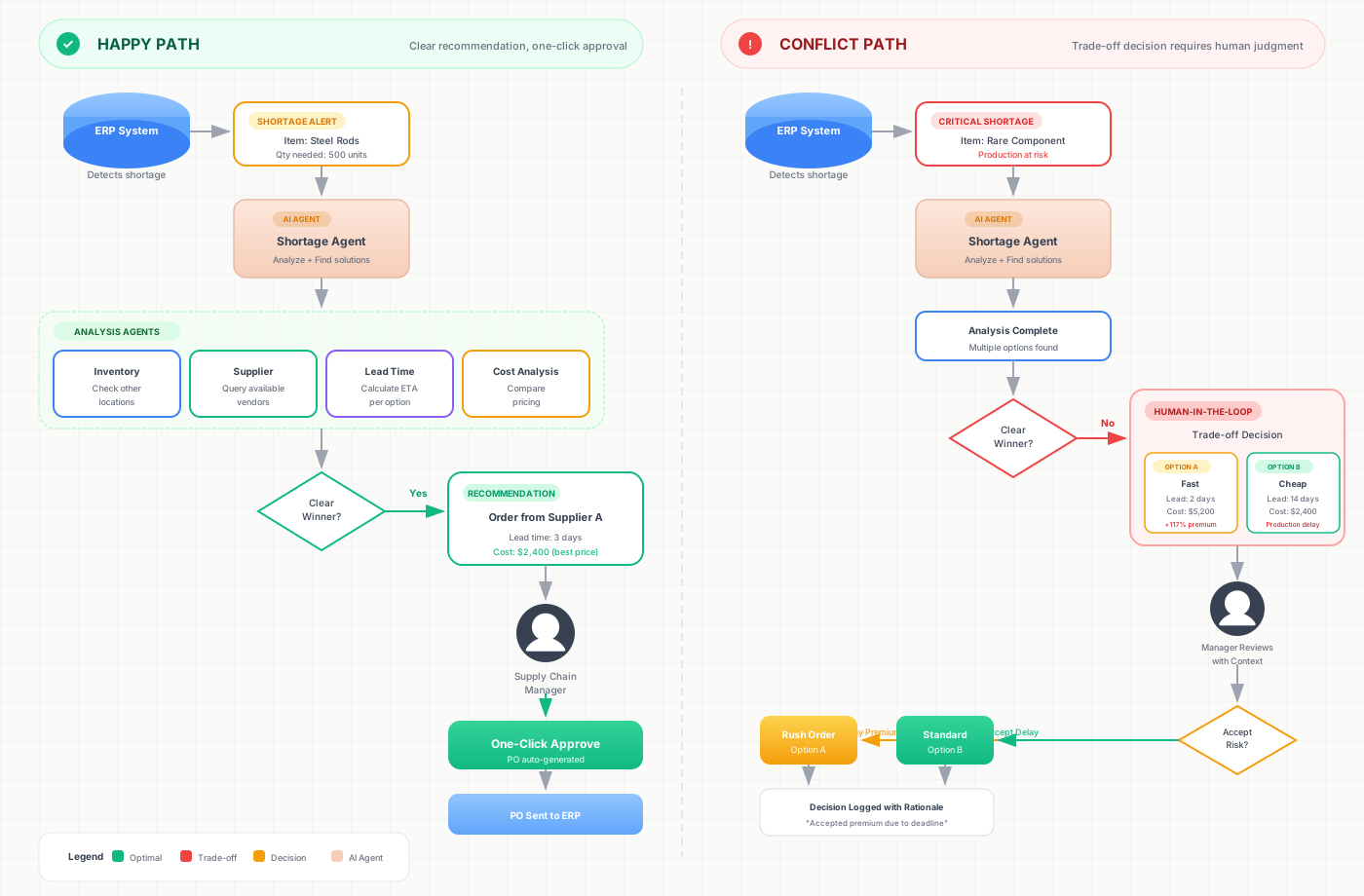
A core design principle: AI handles computation, humans handle judgment. The system defines explicit moments where control transfers between agent and user.
Handoff Design Principles
- Strategy is human-owned — AI never decides the optimization goal
- Recommendations are suggestions — Always overridable with documented reason
- Execution requires confirmation — No auto-send for high-stakes actions
- Every handoff is logged — Full audit trail for compliance
Mapping the full service experience across frontstage interactions, backstage AI operations, and supporting systems.
| Shortage Alert | Strategy Selection | Supplier Review | PO Creation | |
|---|---|---|---|---|
| User Actions | View inbox, click shortage | Choose Speed/Cost/Reliability | Compare options, select supplier | Confirm & send PO |
| Frontstage UI | Severity badge, material details | Strategy cards with weights | Option cards, evidence chips | PO preview, confirmation modal |
| Agent Actions | Detect gap, calculate severity | — | Apply weights, rank, attach evidence | Generate PO, send, log audit |
| Support Systems | ERP inventory feed | Policy rules engine | Contracts DB, historical data | Supplier portal, audit log |
The blueprint reveals where AI acts invisibly (backstage) versus where it surfaces evidence (frontstage) — ensuring transparency without cognitive overload.
When AI systems simply output "Recommended: Supplier X", users can't tell:
- Why this supplier? — What criteria were used?
- What's being traded off? — Is it faster but more expensive?
- Can I override it? — What happens if I choose differently?
"If I pick a different supplier than what the AI recommends, will I get blamed if something goes wrong?"
— Supply Planner concern
"I need to justify my supplier choices to procurement. How do I explain that I overrode the AI's suggestion?"
— Governance concern
Instead of a black-box recommendation, users choose their optimization goal first:
Fastest Delivery
ETA 60% · Price 20% · Reliability 20%
Lowest Cost
Price 60% · ETA 20% · Reliability 20%
Most Reliable
Reliability 60% · ETA 20% · Price 20%
The AI then ranks suppliers according to the selected strategy, with weights shown transparently. Users understand exactly how the ranking was calculated.
Each supplier option shows evidence chips that explain the data sources:
- CONTRACT — Pricing from active contract (Contract ID shown)
- HISTORICAL — On-time delivery rate from past orders
- CALCULATED — Composite score based on strategy weights
This transforms "AI magic" into verifiable, auditable recommendations.
When users select a non-recommended supplier, they must provide a justification:
Override Confirmation
You selected ValueSource Co. instead of the recommended FastParts Inc.
Reason required: "Existing relationship with supplier, need to maintain volume commitment"
Why this matters
- Accountability — Overrides are logged with timestamp and user
- Governance — Auditors can review override patterns
- Learning — Frequent overrides can inform AI model improvements
Every action in the workflow is logged:
- SHORTAGE_CREATED — System detected shortage event
- STRATEGY_SELECTED — User chose optimization goal
- OPTION_SELECTED — User selected supplier
- OPTION_OVERRIDDEN — User overrode recommendation (with reason)
- PO_SENT — Purchase order sent to supplier
Each log entry includes: Actor, Timestamp, Entity ID, and Full Details.
The audit timeline transforms "what did the AI do?" into a complete decision history that can be reviewed for compliance, training, or dispute resolution.
Instead of a persistent panel, transparency now lives inside the task context. Each step surfaces a compact “Agent actions” disclosure that expands only when users need the detail.
- Apply SPEED weights (ETA 60%, Price 20%, Reliability 20%)
- Attach evidence chips (Contract ID, Quote)
- Check override requirement
In the prototype, this stays collapsed by default to keep the UI calm while still discoverable.
Live status is embedded next to the moment users wait: syncing the inbox, ranking options, or sending the PO. These cues feel closer to native app behavior than a separate panel.
Live status cues
These micro-interactions clarify wait time without interrupting decision flow.
Following enterprise app conventions, the prototype features a consistent shell with:
Top Header
App branding, notifications, and persona switcher always visible. Provides context on "who is acting" at any moment.
Left Sidebar
Icon-based navigation to Dashboard, Triage, PO Drafts, and Audit Log. Active state clearly highlighted.
This matches the navigation pattern used in the PR-PO Copilot prototype for consistency across the portfolio.
For prototype demos, the header includes a persona switcher that allows switching between different user roles:
This pattern enables showing how the audit trail captures actor attribution—every action is logged with who performed it, supporting enterprise governance requirements.
Even in a non-chat interface, the agent communicates through labels, status messages, and microcopy. Defining a consistent voice builds trust.
Agent Persona
Name: Shortage Agent
Tone: Professional, direct, evidence-focused
Personality: A meticulous analyst who always shows their work — never vague, never presumptuous
Voice Guidelines
| Principle | Don't | Do |
|---|---|---|
| Be specific | "AI recommended this" | "Recommended based on: Contract C-2024-001 pricing" |
| Show confidence | "This might be the best option" | "Score: 92/100 (Speed 60%, Cost 20%, Reliability 20%)" |
| Respect autonomy | "You should select FastParts" | "FastParts ranks highest for your Speed strategy" |
| Acknowledge limits | "Best supplier found" | "3 suppliers matched criteria. Showing top options." |
Status Message Examples
Patterns are applied in-context so AI behavior stays inspectable without overwhelming the user.
Measuring trustworthiness isn't just about features—it's about how each design choice addresses specific trust dimensions:
| Trust Dimension | Pattern | Implementation |
|---|---|---|
| Transparency | Evidence Chips | Every supplier option shows data source (Contract ID, Historical data, Calculated) |
| Control | Strategy Selection | Users choose optimization goal (Speed/Cost/Reliability) before AI ranks |
| Accountability | Override with Reason | Selecting non-recommended option requires documented justification |
| Governance | Audit Trail | Every action logged with actor, timestamp, entity ID, and details |
| Explainability | Strategy Weights | Ranking formula shown explicitly (e.g., "Speed 60%, Price 20%, Reliability 20%") |
Why this matters
These patterns aren't just "nice to have"—they're the difference between AI users trusting recommendations and blindly accepting (or ignoring) them. In high-stakes supply chain decisions, calibrated trust prevents both over-reliance and under-utilization of AI capabilities.
Trust is earned through transparency
Users don't need to understand the AI's algorithm—they need to see the evidence behind each recommendation and have the power to override when their domain expertise says otherwise.
Human-in-the-loop ≠ Human bottleneck
The goal isn't to make humans approve everything—it's to put humans in control of strategy and exceptions while letting AI handle the repetitive scoring and ranking.
Governance is a UX problem
Audit trails and override logging aren't just for compliance—they protect users by documenting their decision rationale when things go wrong (or right).
Beyond decision support: A maturity path
This prototype represents Level 2 of an AI maturity model:
- Level 1: Visibility — AI surfaces data (dashboards, alerts)
- Level 2: Recommendation — AI suggests, human decides (this prototype)
- Level 3: Delegation — AI acts within guardrails, human monitors
- Level 4: Autonomy — AI handles routine cases, human handles exceptions
The trust patterns established here — evidence, override, audit — scale across all levels.
Challenges & what I'd do differently
Designing without production data
Using seeded/mock data limits validation. Real supply chain data has messy edge cases—partial shipments, multi-source orders, quality variations—that I couldn't fully model. Next time: Partner with a procurement team earlier, even for read-only data access.
Strategy selection complexity
Three strategies (Speed/Cost/Reliability) is simple to explain but may be too rigid. Real procurement often involves multi-objective optimization. If I revisited: Explore customizable weight sliders instead of preset strategies.
Accessibility & responsive considerations
Accessibility
- Confidence bars use pattern fills alongside color
- Strategy cards have clear focus states
- Override modals respect focus trapping
- Screen reader-friendly table structures
Responsive Design
- Dashboard adapts to tablet/desktop viewports
- Recommendation cards stack on smaller screens
- Critical actions remain accessible on mobile
- Data tables scroll horizontally when needed
Building recommendation systems is about more than accuracy—it's about giving users the confidence to act on recommendations, even when they can't audit every calculation themselves.